Introducing Huma-2
Memory: Building a Custom Memory Persistence Layer for Smarter AI Agents
Learn how to build a custom persistence layer that gives AI agents long-term memory for personalized, context-aware, and continuous interactions.
The biggest hurdle for AI agents today isn't their intelligence - it's their amnesia. Most standard LLM implementations operate within a "session vacuum", where every new interaction feels like a first date.
To bridge this gap, we've implemented a custom memory persistence layer designed to give our agents a long-term "brain". Here's a high-level look at how we're evolving our agents from simple chat interfaces into personalized assistants.
How the memory layer works
Our architecture goes beyond basic message history. We've built a dynamic loop that allows the agent to treat memory as a living database.
Contextual retrieval: At the start of conversation, the agent doesn't just see the current chat. It performs a lookup of past memory entries associated with the user, injecting relevant historical data directly into the current conversational context.
Real-time analysis: As the conversation progresses, the agent acts as its own librarian. It analyzes user messages in the background to determine if a piece of information is worth saving for the future.
Dynamic updates: If a user's preference change (e.g., "I'm actually moving to London next month"), the agent identifies the conflict and updates the existing memory entry rather than just creating redundant logs.
Personalization through persistence
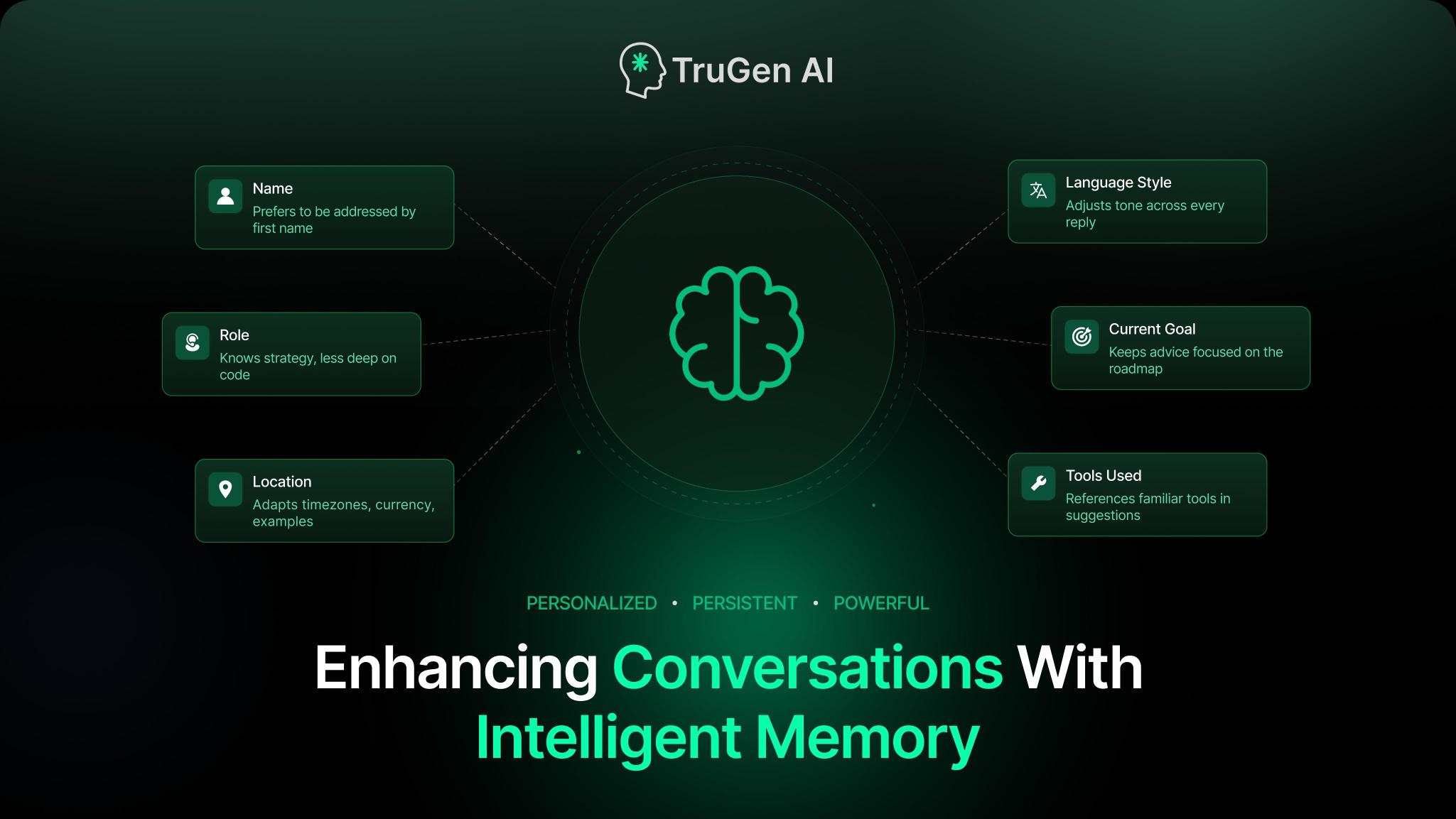
The ultimate goal of this layer is flow personalization. When an agent remembers that you prefer Python over Java, or that you're working on a specific project from three weeks ago, the user experience transforms.
By pulling in these specific "memory fragments", the agent can bypass repetitive introductory questions and jump straight to high-value problem solving. It creates a seamless continuity that feels less like a tool and more like a collaborator.
Governance: Defining what to remember
Giving an AI a "photographic memory" isn't always ideal. There's a fine line between helpfulness and noise. To manage this, we've implemented a natural language control layer.
Using custom instructions, we can define the "scope" of the agent's memory. For example we can instruct the agent to
- Prioritize: "Always remember the users' preferred tech stack and project deadlines"
- Ignore: "Do not store any sensitive PII (Personally Identifiable Information) or casual small talk about the weather."
This allows us to fine-tune the agent's focus using simple prompts, ensuring the memory says lean, relevant, and secure.
Why this matters
By decoupling memory from the immediate chat history, we've enabled our agents to build a consistent, evolving profile of their users. This persistence layer is the foundation for AI that doesn't just respond, but actually understands the long-term context of the work it's doing.
This allows us to fine-tune the agent’s focus using simple prompts, ensuring the memory stays lean, relevant, and secure.