Introducing Huma-2
EngineeringProduct Updates
Under the Hood: How TruGen Turns Your Deck into a Presenting Agent
How Visual Presentations parses your documents, extracts content with a hybrid engine, and uses a proprietary knowledge base to make slide retrieval fast and reliable.

Venkata Deepak Reddy Medam
Updated Sep 18, 2026
4 min read
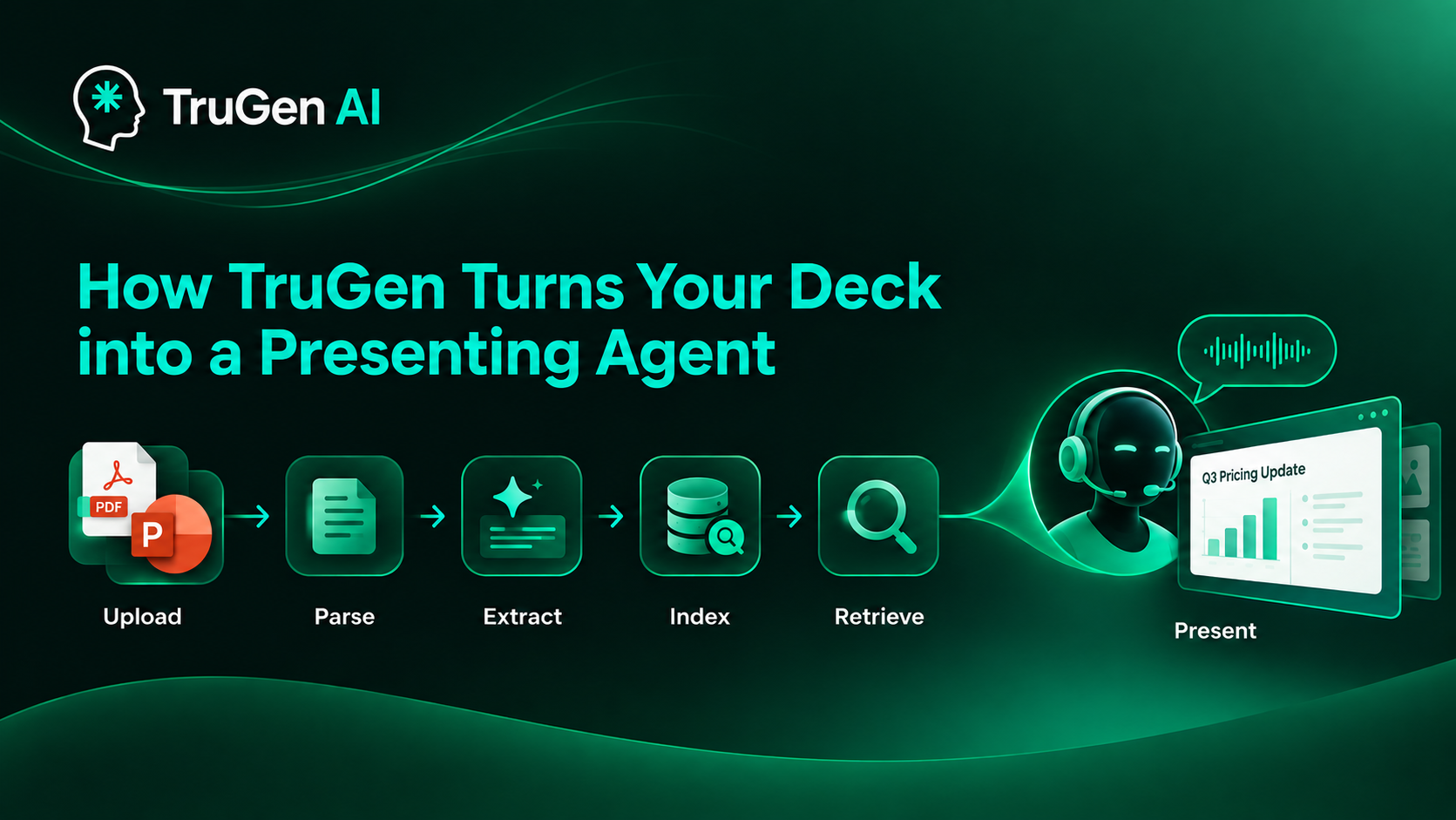
When you upload a deck to TruGen's visual presentations, the agent doesn't just attach a file. By the time a user asks their first question, every slide has been parsed, understood, and indexed - so the agent can pull up the exact pricing table or architecture diagram mid-conversation, while it speaks.
This post walks through what happens between upload and that first presented slide.
The pipeline at a glance
1. Upload - you add a PDF or PowerPoint deck (up to 100 MB) in the Studio or via the API.
2. Parse - each document is split into its atomic unit: pages for PDFs, slides for PPTX.
3. Extract - an intelligent content extraction engine reads structure and meaning from every slide.
4. Index - the proprietary knowledge base engine turns extracted content into a searchable index.
5. Retrieve and present - at query time, the agent semantically matches the question to a slide, then speaks the answer and shows the slide together.
Steps 2–4 run asynchronously while the presentation moves through
pending → processing → completed. Once complete, it's ready to attach to any agent.Parsing: turning files into slides
Parsing has two jobs: split the document and normalize what it finds.
PDFs are page-split: Each page becomes one slide, which maps naturally to how decks are designed: one idea per page.
PowerPoints are slide-indexed: The parser walks the PPTX structure slide by slide, capturing text frames, titles, and layout information.
Normalization then produces a single internal representation regardless of source format. Every slide becomes the same shape: a title, body content, and metadata about what the slide contains. This matters downstream - the extraction and indexing stages never need to know whether a slide came from PDF or PowerPoint.
Intelligent content extraction: hybrid by design
Raw text alone is a poor signal. "Slide 12: Q3" tells a retrieval engine almost nothing. The extraction engine layers two kinds of understanding:
Deterministic extractors handle structure. They parse layout to find titles, order text the way a human reads it, and weight elements - slide titles carry more signal than footer text. These passes are fast, cheap, and deterministic: the same slide always produces the same result.
A language model pass handles meaning. It reads the structured output and enriches each slide with topic labels, summaries, and the kinds of questions the slide can answer. This is what turns "Q3 Pricing Update" from a title string into something the engine can match against "how much does the enterprise tier cost?"
The hybrid split is deliberate. Heuristics guarantee speed and consistency; the LLM pass adds depth only where it adds value. A text-heavy slide and a mostly-visual diagram both end up retrievable - not just the ones with clean text.
The proprietary knowledge base engine
Extraction produces understanding. The knowledge base engine makes it usable at conversational speed, and it's built in-house for two reasons: speed and reliability.
Speed: Slide retrieval happens mid-conversation - the agent searches before it answers, so a slow index means a slow answer. The engine maintains pre-computed indexes per deck, caches aggressively, and retrieves in sub-second time so presentation lookup never becomes the bottleneck of a live session.
Reliability: Slide retrieval shares the same foundation as Knowledge Base retrieval: one consistent, battle-tested engine instead of a glue layer of third-party components. Retrieval quality is uniform across decks, agents, and sessions, and the engine degrades gracefully - when no slide is a strong match, the agent simply answers from its system prompt and knowledge base. No broken slide flashes on screen.
The engine also handles deck metadata. The name and description you give a presentation aren't labels; they're routing signals the agent reads to decide which deck to search before deciding which slide to show.
Designing decks the engine can use
The pipeline is built to understand real-world decks, but a few habits measurably improve retrieval:
- Split large decks by topic Five focused 20-slide decks retrieve better than one 100-slide master.
- Use clear slide titles Titles are heavily weighted in retrieval. "Q3 Pricing Update" beats "Slide 12".
- Prefer PDF when you can PDFs process faster and extract cleaner.
- Write specific names and descriptions They route the agent to the right deck.
- Test like a user Ask 5–10 real questions in a test session and watch which slides surface.
Try it
Upload a deck, attach it to an agent, and ask a question the deck answers.
#rag#document parsing#semantic search#pdf processing#presentation automation#knowledge indexing