Introducing Huma-2
Guardrails for Agents
Agents can take real actions—send emails, move money, delete records. Unlike chatbots, a bad decision isn't just an awkward reply. Guardrails are checkpoints between deciding to act and acting.

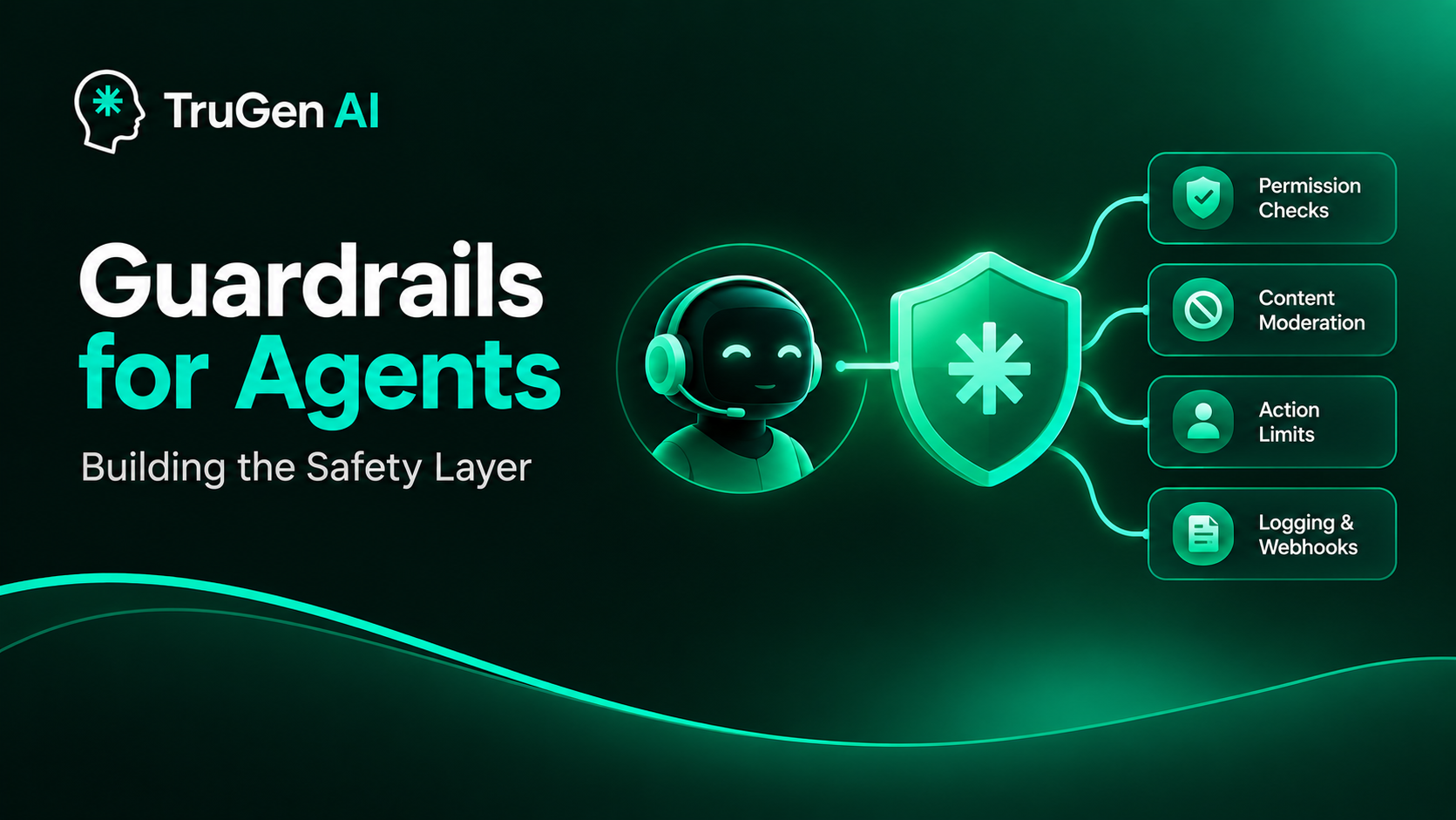
Building the Safety Layer
A simple chatbot's worst case is a bad reply. An agent's worst case is a bad action — sending the wrong email, issuing the wrong refund, deleting the wrong record. Guardrails exist so that the actions an agent takes are ones you would have approved.
One thing is worth stating up front, because it shapes everything else: in most agent frameworks, trugen included, a guardrail isn't a wall the runtime forces every action through. It's a tool the model chooses to call. That makes guardrails cheap to add and easy to reuse, but it also means their reliability is something you design for, not something you get for free.
Why Agent Actions Need Guardrails
A support agent that gets a fact wrong is embarrassing. One that issues a refund it shouldn't have has already moved real money. Once an agent has write access to something real — money, records, outbound messages — you want a checkpoint between deciding to act and acting. The rest of this post is about what that checkpoint can and can't do.
Permissions vs. Safe Decisions
Giving an agent a tool defines what it can do, not what it should do right now. A refund tool with no guardrail will refund whatever the model decides to refund, including a request planted by prompt injection. The capability is a standing permission; safety is a decision made fresh at the moment of use. A guardrail is where you put that decision.
Guardrails Scale With Autonomy
A read-only agent mostly needs guardrails on what it says. An agent that can take irreversible actions needs guardrails on what it does, and they should get stricter as the action gets harder to undo. The same category — a "refund limit," say — means something very different on a five-dollar order than on a five-thousand-dollar one, so the threshold, not just the rule, is part of the design.
How a Guardrail Actually Fires
This is the part most write-ups skip. A guardrail is exposed to the agent as a tool it can call before it speaks or acts, not a filter applied to the output afterward. On each turn, the model weighs the message against every attached guardrail's description and decides whether one applies, exactly like any other tool call. If it calls one, the turn resolves in one of two ways. A canned-response guardrail speaks a configured message and stops, with no external call needed. A moderation-style guardrail hands the content to an external check — a moderation model or rule service — and acts on the verdict it gets back. Either way, the trigger can also fire an event to a webhook, which we'll get to.
The Prompt Is Part of the Guardrail
Here's the caveat that follows directly from the above: a guardrail only runs if the model decides to call it. There's no code-level enforcement standing behind it. If your system prompt never tells the agent that these checks exist and must be used, the most common failure isn't a misconfigured guardrail — it's a guardrail that simply never fires. So treat the instruction to check guardrails as part of the guardrail itself. And if you need a check that genuinely cannot be skipped, don't rely on a model-invoked tool for it; enforce it deterministically in your own code, before the turn ever reaches the agent.
Handling False Positives and Negatives
A triggered guardrail is a signal, not a final verdict. Moderation checks have false positives and false negatives, so every trigger needs a response you chose on purpose: block and explain, ask the user to confirm, or escalate to a human. Decide that per guardrail, rather than defaulting to whatever the check happened to return.
Log Every Trigger
Every trigger is worth a record — it's your evidence for whether a guardrail is working, too strict, or too loose. Give each guardrail an optional webhook URL and fire an async POST whenever it triggers. A guardrail_triggered event looks roughly like this:
{
  "event": "guardrail_triggered",
  "guardrail": { "name": "refund_limit", "category": "financial" },
  "content": "Can you refund my last three orders, about $840 total?",
  "response_message": null,
  "verdict": { "allow": false, "reason": "exceeds auto-approval limit" },
  "conversation_id": "c1a2...",
  "speech_id": "sp_88f...",
  "agent_id": "agt_41...",
  "timestamp": "2026-09-11T13:02:44Z"
}
The call should never block the conversation. And because the payload carries conversation_id and speech_id, every logged trigger traces back to the exact turn that caused it — which is what makes tuning possible instead of guesswork.
Not Everything Belongs in a Model-Invoked Guardrail
Reserve model-invoked guardrails for judgment calls. Cheap, deterministic checks — allow-lists, regex, hard limits — don't need a model and shouldn't wait on one; run them in your own code or tools before the agent turn and let them catch what they can. Save the judgment-heavy checks for what's left. A single heavyweight filter on every message is slower and often less accurate than a few cheap deterministic checks up front plus one good model check behind them.
Putting It Together
End to end: deterministic checks run first, in code. What needs judgment is handled by guardrails the model calls as tools — canned responses for the clear-cut cases, moderation checks for the rest. Every trigger is logged asynchronously to a webhook. None of this needs to be visible to the user. It just needs to be reliable enough — through good prompting, sensible thresholds, and the logs that let you tune both — to trust the agent with more autonomy over time.
Conclusion
Guardrails aren't a constraint bolted on as an afterthought; they're what makes real autonomy workable. An agent earns more freedom to act as more of what it does runs through a check, a decision, and a logged record — and as your logs show those checks are firing when they should. That's the shape of the safety layer: cheap where it can be, precise where it must be, honest about what the model will and won't do on its own, and always leaving a trail.